What Is Vipassanā Meditation?
Updated November 2026
Vipassanā is insight meditation. The Pali word is usually translated as "insight" or "seeing correctly", and the practice means observing sensations, feelings and emotions in your own body to come to an understanding of impermanence (anicca) of all the things you normally see as personal. In the tradition of Sayagyi U Ba Khin and Mother Sayamagyi, it is learned on a ten-day course, after first calming the mind with Ānāpāna meditation.
Vipassanā at a glance
| What it is | Insight meditation from the Theravada Buddhist tradition |
|---|---|
| What the word means | "Insight" or "seeing things as they are" (Pali) |
| What you observe | Physical and mental processes as they arise and pass away |
| What you come to understand | Impermanence (anicca), unsatisfactoryness, imperfection (dukkha) and absence of anything controlling in mind and matter (anattā) |
| What comes first | Calm and concentration through Ānāpāna, mindfulness of breathing |
| How it is taught here | A residential ten-day course in the tradition of Sayagyi U Ba Khin and Mother Sayamagyi |
What does Vipassanā actually mean?
Vipassanā means seeing clearly. Clear, intuitive insight into physical and mental phenomena as they arise and pass away, seen in terms of the three characteristics: impermanence, unsatisfactoryness and absence of a controlling self.
You have to see it for yourself. Reading about impermanence, or agreeing with the theory, scientific or Buddhist, does not have a lasting effect. The practice is to experience change directly in your own body and mind, until the understanding stops being an idea and becomes something you know through experience.
How is Vipassanā practised in the tradition of Sayagyi U Ba Khin and Mother Sayamagyi?
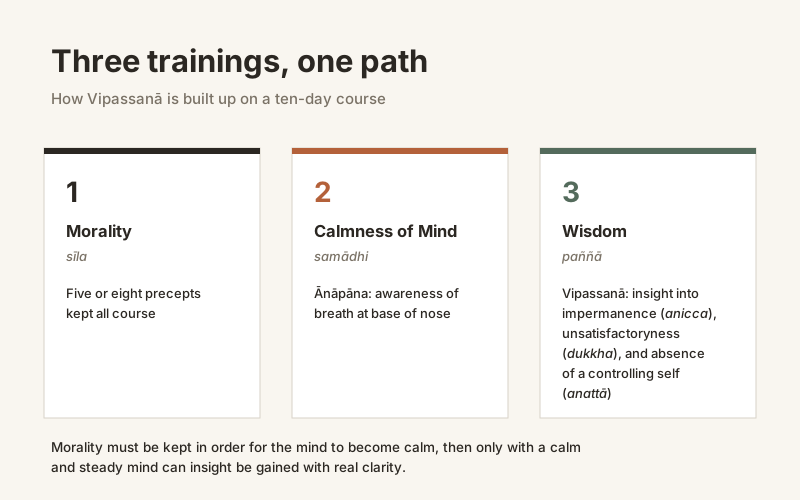
The practice follows the Buddha's Eightfold Noble Path as three trainings, taken in order:
- Right Conduct (sīla). For the duration of a course, students keep five precepts: no killing, no stealing, no sexual activity, no lying and no intoxicants.
- Calmness of Mind (samādhi). For the first four and a half days, students practise Ānāpāna, keeping attention on the breath at a spot at the base of the nose. When the mind has only one object, it becomes calm and steady.
- Insight, Wisdom (paññā). With the mind in a perfect state of balance, students turn the attention inward and practise Vipassanā for the rest of the course.
Anicca comes first
This tradition puts impermanence at the centre. Its teaching says impermanence (anicca) is the essential factor that must be experienced first and understood through practice. Intellectual knowledge of the Dhamma is not enough.
In practice, students move their attention through the body, from head to feet, and observe sensations. They are told not to attend to anatomy. Instead they attend to the formation of matter and to its constant change. In this teaching, insight into impermanence comes first, and understanding of unsatisfactoryness and absence of a controlling self develops with it.
Why Ānāpāna before Vipassanā?
Vipassanā needs a calm, steady mind. Ānāpāna gives the mind one object, the breath, which is natural, always available, and common to everyone regardless of view. Once the mind is calm and focused, it has the balance Vipassanā needs.
Is Vipassanā Buddhist?
Yes. Vipassanā is the insight practice taught by the Buddha and preserved in the Theravāda tradition. But you don't need to be a Buddhist to practise it. Ānāpāna uses the breath, which is common to all human beings, and students on our courses come from many religions and backgrounds. What you need is an open mind and the willingness to give the technique a fair trial.
How do you learn Vipassanā?
In this tradition, Vipassanā is learned on a residential ten-day course with a teacher. At the UK Centre, courses run every month, from a Friday evening to early on a Monday morning. Students meet the teacher every day for personal guidance. There is no charge for the teaching; a donation of £300 is suggested for food and accommodation. See the ten-day course for the timetable and how to apply. You can read about the teachers of this tradition on our Teachers page, and about how Vipassanā is taught at IMC.
What Vipassanā is not
- Calm is a step on the way, not the goal. The goal is insight into the nature of body and mind, so Vipassanā is not a relaxation technique.
- You are not asked to believe anything. The teaching is through experience: if what you experience is for your wellbeing, you can accept it, if it is not, you will not.
- Vipassanā is not a medical or psychological treatment. If you have a history of mental health difficulties, say so on the application form and talk to the Centre before you apply.
- A web page can explain the practice but can't teach it. That needs a teacher.
Frequently asked questions
What does Vipassanā mean?
Vipassanā is a Pali word usually translated as "insight" or "seeing things as they are". In meditation it means experiencing directly, in your own body and mind, that physical and mental processes arise and pass away. That direct experience leads to understanding.
What is the difference between Vipassanā and Ānāpāna?
Ānāpāna is mindfulness of breathing. It develops a calm, equanimous mind by keeping attention on the sensation of the breath in the region of the nostrils. Vipassanā is insight meditation, which uses that balanced mind to observe change throughout body and mind. In the Sayagyi U Ba Khin and Mother Sayamagyi tradition, students practise Ānāpāna first, then Vipassanā.
Who was Sayagyi U Ba Khin?
Sayagyi U Ba Khin (1899 to 1971) started to practise Vipassanā meditation in 1937 under Saya Thetgyi, a disciple of the Venerable Ledi Sayadaw and one of the first lay meditation teachers in Burma (Myanmar). His aspiration was to give lay people, who lead busy and often unsettled lives, a tool to understand through practice the teachings of the Buddha, so he designed the Ten-Day Course.
Can I learn Vipassanā on my own?
Not easily. This guide can explain what Vipassanā is, but the tradition teaches it in person, on a ten-day residential course with a teacher. Students receive individual instruction in a daily interview, so the teacher can guide each person's practice. You don't need any previous meditation experience.
Do I have to be a Buddhist to practise Vipassanā?
No. Vipassanā comes from the Theravada Buddhist tradition, but you don't need to be a Buddhist to learn it. The breath and the body are common to everyone. Students of many religions and backgrounds attend our courses, and the requirement is an open mind and a fair trial of the technique.
In short
- Vipassanā means insight: seeing impermanence, unsatisfactoryness and absence of a controlling self directly, in your own body and mind.
- In the Sayagyi U Ba Khin and Mother Sayamagyi tradition, students first calm the mind with Ānāpāna, then practise Vipassanā, with anicca as the focus.
- It is taught on a residential ten-day course. You don't need to be a Buddhist.