10-Day Vipassanā Meditation Course in the UK
Updated November 2026
The International Meditation Centre holds a residential ten-day course of Vipassanā Meditation in the UK every month, at its centre in Heddington, near Calne in Wiltshire. Courses begin on a Friday evening and end early on a Monday morning. There is no charge for the teaching. There is a suggested donation to help cover the costs of food and utilities, about £30 per day per student.
The course at a glance
| Length | Ten days, Friday evening to early Monday morning |
|---|---|
| Dates | Usually once a month. See course dates |
| Where | Splatts House, Heddington, Calne, Wiltshire SN11 0PE |
| Cost | No charge for the teaching. £300 suggested donation for food and accommodation |
| What you learn | Ānāpāna (mindfulness of breathing), then Vipassanā (insight) meditation |
| Tradition | Sayagyi U Ba Khin and Mother Sayamagyi |
| Who can come | Anyone with an open mind. You don't need to be a Buddhist |
| How to apply | Paper form, by post or scanned and emailed. See how to apply |
What happens on a ten-day course?
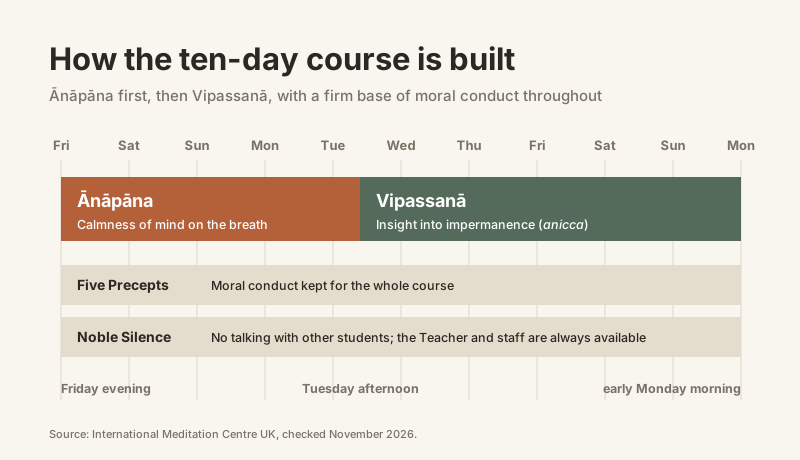
You learn two kinds of meditation in sequence. For four and a half days you practise Ānāpāna, resting your attention at a spot at the base of the nose where you can feel the touch of the breath entering and coming out until the mind settles. For the rest of the course you practise Vipassanā.
Vipassanā means insight. With the mind calm and balanced, you observe the changes in the physical and mental processes within yourself and come to know impermanence, unsatisfactoryness or imperfection and absence of a controlling permanent self through your own direct experience rather than through belief. The whole course follows the Eightfold Noble Path as three trainings: right conduct (sīla), calmness of mind (samādhi) and insight (paññā).
Sayagyi U Ba Khin designed this ten-day format in Burma (Myanmar) so that busy lay people could learn the practice in one short, concentrated period.
What does a typical day look like?
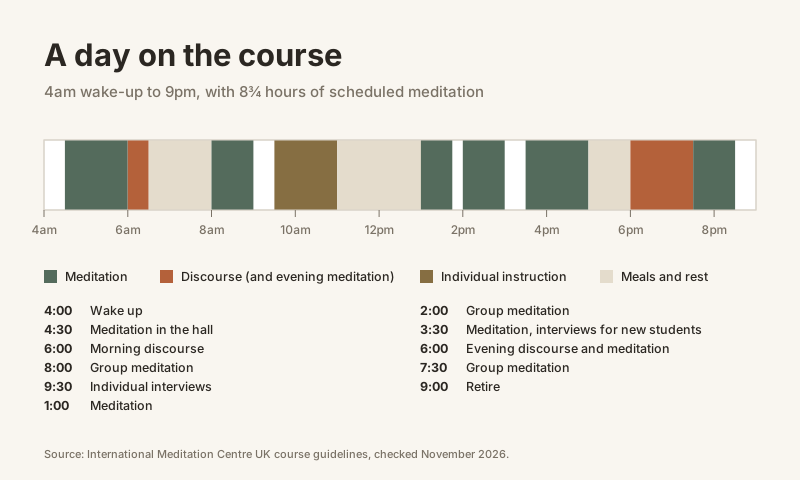
The day starts with a 4am wake-up and ends at 9pm. Across the day there are eight and three-quarter hours of scheduled meditation, plus a morning discourse, an evening discourse and time with the Teacher. Meals and rest periods sit in between.
| Time | Activity |
|---|---|
| 4:00 am | Wake up |
| 4:30 – 6:00 | Meditation in the hall |
| 6:00 – 6:30 | Morning discourse |
| 6:30 – 8:00 | Breakfast and rest |
| 8:00 – 9:00 | Group meditation in the hall |
| 9:30 – 11:00 | Individual interviews |
| 11:00 – 1:00 pm | Lunch and rest |
| 1:00 – 1:45 | Meditation |
| 2:00 – 3:00 | Group meditation in the hall |
| 3:30 – 5:00 | Meditation, and interviews for new students |
| 5:00 – 6:00 | Tea and rest |
| 6:00 | Evening discourse and meditation |
| 7:30 – 8:30 | Group meditation in the hall |
| 9:00 | Retire for the evening |
That is a long day, especially at first. Still, the schedule follows the Middle Path. The schedule is not rigid and can be adjusted for individual needs. Sayagyi U Ba Khin taught his students to work with "zestful ease".
What are the course rules?
For the whole course you keep five precepts: no killing, no stealing, no sexual activity, no lying, and no intoxicants or drugs. You also keep noble silence, which means you don't talk with the other students. You can speak with the Teacher and the staff whenever you need to.
You set aside any other meditation or spiritual practice for the ten days, and you don't bring spiritual objects or reading or writing material. You stay at the Centre for the whole retreat. The full rules are on the course guidelines page.
How much does a ten-day course cost?
There is no charge for the teaching, and there never has been at the Centre. We suggest a donation of £300 for a ten-day course. It goes towards the cost of your food and accommodation while you are here. If it is difficult for you to contribute the full amount, please contact management.
Who teaches the courses?
UK courses are led by Mr Roger Bischoff, who lives at the Centre and also teaches abroad, and by other teachers in the tradition. The dates page names the teacher for each course. Every student meets the Teacher daily for personal guidance.
The teaching comes from Sayagyi U Ba Khin (1899 to 1971), who founded the International Meditation Centre in Rangoon in 1952, and his foremost disciple Mother Sayamagyi. She taught alongside him from 1953, then taught in the West from 1978 until she passed away at the UK Centre in January 2017. Read more about our teachers.
Is the course right for me?
The course is open to anyone who comes with an open mind and the intention to give the technique a fair trial. You don't need to be a Buddhist. Our students come from all walks of life, professions, religions and cultural backgrounds.
Ten days of practice is hard work. The application form asks about your physical and mental health and any medication you take, so the Teacher and staff can plan for you and look after everyone's wellbeing. Please answer it fully. If you're unsure whether now is the right time, contact the Centre before you apply. The course is not a medical or psychological treatment and does not replace advice from your doctor.
If ten days isn't possible, you can come for the first weekend only. First-time students are normally accepted only if they can stay at least three full days.
Where is the Centre, and how do I get there?
The Centre is on the edge of Heddington, a small village in rural Wiltshire. The nearest town with a main railway station is Chippenham, about 8 miles away by taxi. By car it is about 25 minutes from junction 17 of the M4.
From London, trains from Paddington to Chippenham take a little over an hour. There is a taxi rank at Chippenham station, or you can book a taxi ahead. Buses run from Chippenham to Calne, with an infrequent service on to Heddington. Taxi numbers and bus details are on the directions page.
What are the food and accommodation like?
Meals are vegetarian, with a wide range of dishes and full allergen information for every meal. Lunch always includes rice, steamed vegetables and a salad. We can't cater for individual requests, but the application form asks about medically confirmed food allergies. Accommodation is mostly shared. Let us know if you have special needs.
What should I know before I arrive?
- Arrival: please arrive on the Friday between 3 and 6pm.
- What to bring: loose-fitting, modest clothing. Bedding and meditation cushions are provided.
- Phones and devices: these are not permitted during the course. The management stores them securely and returns them on the last day.
- Reading and writing: not permitted during the course.
- Age: students must be 18 or over, unless accompanied by a guardian.
How do I apply?
- Read the course guidelines.
- Choose a date on the course dates page.
- Download and fill in the application form.
- Post it to the Centre, or scan it and email it. Details are on the registration page.
Next UK courses: 13 to 23 November 2026, 18 to 28 December 2026, 22 January to 1 February 2027.
Frequently asked questions
Is the ten-day course free?
There is no charge for the teaching, and there never has been at the Centre. We suggest a donation towards the costs of food and accommodation for the ten days, which is about £30 per day per person, so £300 for ten days.
Do I have to stay for all ten days?
Students are asked to stay for the whole course. There is an option to come for the first weekend only and practise right conduct and concentration. First-time students are normally accepted only if they can stay at least three full days, because it takes that long for the benefits to show.
Can I talk to anyone during the course?
Students keep noble silence, so you don't talk with the other students. You can speak with the Teacher and the staff at any time, about the meditation or about practical needs. You also meet the Teacher every day for personal guidance on your practice.
Do I need any meditation experience?
No. The course teaches the technique from the start, beginning with Ānāpāna, awareness of the breath. If you already practise another method, you set it aside for the ten days. The application form asks about any meditation you do, so the Teacher knows your background.
Is the course religious?
The course teaches Buddhist meditation in the Theravada tradition, but you don't need to be a Buddhist to attend. You need an open mind and the willingness to give the technique a fair trial. Students of many religions and cultural backgrounds have taken the course.
How far is the Centre from London?
Trains from London Paddington to Chippenham take a little over an hour. From Chippenham station the Centre is about 8 miles by taxi, and there is a taxi rank at the station. If you drive, the Centre is about 25 minutes from junction 17 of the M4.
Can I bring my phone?
Phones and other devices are not permitted during the course. The management stores them securely when you arrive and returns them on the last day, so you can stay fully with the practice for the ten days.
In short
- A residential ten-day Vipassanā course, held every month near Calne, Wiltshire.
- No charge for the teaching; £300 suggested donation for food and accommodation.
- Four and a half days of Ānāpāna, then Vipassanā, with about 8¾ hours of scheduled meditation a day.
- Noble Silence with other students, daily guidance from the Teacher.
- Apply with the completed PDF application, by email or by post.