How Vipassanā Is Taught at IMC: In the Sayagyi U Ba Khin and Mother Sayamagyi Tradition
At the International Meditation Centre, Vipassanā is taught the way Sayagyi U Ba Khin designed it for lay people: a ten-day residential course led by a teacher of the tradition, with individual instruction every day. Students first calm the mind with Ānāpāna, then practise Vipassanā with the focus on impermanence (anicca), experienced directly in the body.
- Who leads courses
- A teacher in the tradition of Sayagyi U Ba Khin and Mother Sayamagyi, named on the dates page
- Personal guidance
- Individual instruction for every student each day, and daily interviews with the Teacher
- First stage
- Ānāpāna: attention on the touch of the breath at a spot in the region of the nostrils
- Second stage
- Vipassanā, with impermanence (anicca) as the object
Last updated: 12 November 2026
Who leads the courses?
Every course is led by a teacher of the tradition. At the UK Centre this is usually Mr Roger Bischoff, the leading disciple of Mother Sayamagyi, who lives at the Centre and also teaches abroad. Some courses are led by other teachers in the tradition, and the dates page names the teacher for each one.
What personal guidance do students get?
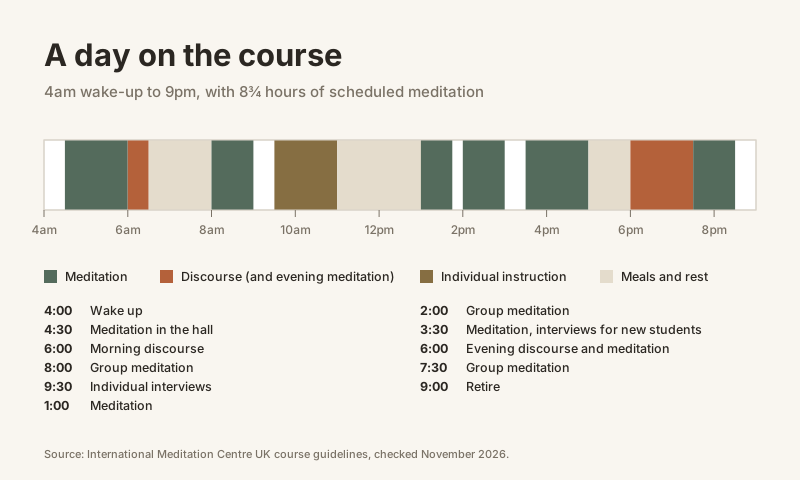
Guidance is built into the timetable. Every morning at 9:30 all students receive individual instruction, and in the afternoon there are additional interviews for new students. Every student has a daily interview with the Teacher, and the guidelines ask students to give a true and accurate account of their experience so the guidance fits them.
Outside those times, students keep noble silence with each other but can speak to the Teacher and the staff at any time. There is a morning discourse and an evening discourse each day, both given in person.
How is Ānāpāna taught?
Ānāpāna comes first, for the first four and a half days. Students keep their attention on the breath at a spot at the base of the nose, aware of the touch of the breath as it goes in and out. The breath is used because it is natural, always available, and common to everyone, whatever their religion or none.
Why does the practice centre on anicca?
In the teachings of the Buddha impermanence (anicca) is the essential factor that must be experienced first and understood through practice. Knowing about it through reading is not enough. The aim is to experience change directly, in yourself. From that experience, understanding of unsatisfactoryness (dukkha) and non-self (anattā) develops, and with it, a gradual softening of reactions such as anger and desire.
Is the course very strict?
The course asks a lot: a 4am start, eight and three-quarter hours of scheduled meditation a day, five precepts, and noble silence. But the schedule can be adjusted to individual needs. Sayagyi U Ba Khin taught his students to work with "zestful ease".
A teaching designed for lay people
Sayagyi U Ba Khin was not a monk. He was a government official who became the first Accountant General of independent Burma, and he first taught meditation to the staff of his own office. He designed the ten-day course so that busy lay people could learn the practice in one concentrated period.
The Centre's courses are still open to lay people of any background. You don't need to be a Buddhist. If ten days isn't possible, you can come for the first weekend, though first-time students must stay three full days. And there is no charge for the teaching. See the 10-day Vipassanā course for the timetable and how to apply.
Experience, not belief
You are not asked to accept anything on faith. The teaching is through experience: if what you experience is for your wellbeing, you can accept it, and if it is not, you need not. The written texts of Sayagyi U Ba Khin are free to download from our publications page for anyone who wants to read further.
What the course can and can't do
The Teacher guides you, but the work is yours, and the benefits depend on the balanced effort you make. The course is not a medical or psychological treatment. If you have a history of mental health difficulties, say so on the application form and talk to the Centre before you apply.
Frequently asked questions
Who teaches Vipassanā at IMC UK?
Courses at the UK Centre are led by teachers of the tradition of Sayagyi U Ba Khin and Mother Sayamagyi. Mr Roger Bischoff, Mother Sayamagyi's leading disciple, lives at the Centre and leads most courses. Other teachers in the tradition lead some courses, and the dates page names the teacher for each.
Do I get to speak to the teacher?
Yes. Every student receives individual instruction each morning and has a daily interview with the Teacher. Students keep noble silence with each other, but can speak to the Teacher and the staff at any time during the course, about their practice or about practical needs.
What does "anicca" mean?
Anicca is the Pali word for impermanence. Experiencing impermanence directly is the essential first step towards understanding unsatisfactoryness and the absence of a stable controlling self.
Can I follow a course from my home?
Parallel to courses at IMC UK, IMC USA and IMC New South Wales, a virtual course is offered to people who have attended a course in this tradition before. Contact your Centre to ask for information.
Do I need to read about Buddhism first?
No. The teachings of the Buddha can be fully understood through direct experience rather than book knowledge, and the course teaches the technique from the beginning. If you would like to read further, the written texts of Sayagyi U Ba Khin are free to download from the publications page.
In short
- Courses are led by a teacher of the Tradition of Sayagyi U Ba Khin and Mother Sayamagyi, with individual instruction every day.
- Ānāpāna comes first, then Vipassanā with anicca, impermanence, as the object.
- The pace follows the Middle Path, "zestful ease".
- The course was designed for lay people. You don't need to be a Buddhist, and there is no charge for the teaching.